In the daily operating expenses of a commercial laundry facility, energy costs consistently take up the lion’s share. When laundry owners consider purchasing or upgrading a 120kg industrial dryer, the most critical question is often: How much does it actually cost in natural gas to dry a full batch of linen?
To calculate the exact figures, we must first examine baseline energy consumption data. Based on an industrial natural gas benchmark of approximately 3.8 RMB/m³ and a standard moisture content of 60%–70% post-extraction for terry towels and bed sheets:
Conventional standard 120kg dryers on the market mostly utilize traditional side-intake or rear-intake ductwork. With long airflow paths and significant heat loss, their drying cycles typically require 55 to 70 minutes. The average gas consumption per batch ranges from 10 to 13 m³, which translates to a gas cost of 38 to 49.4 RMB per batch. If a machine processes 20 batches a day, the daily natural gas expense approaches nearly 1,000 RMB per unit.
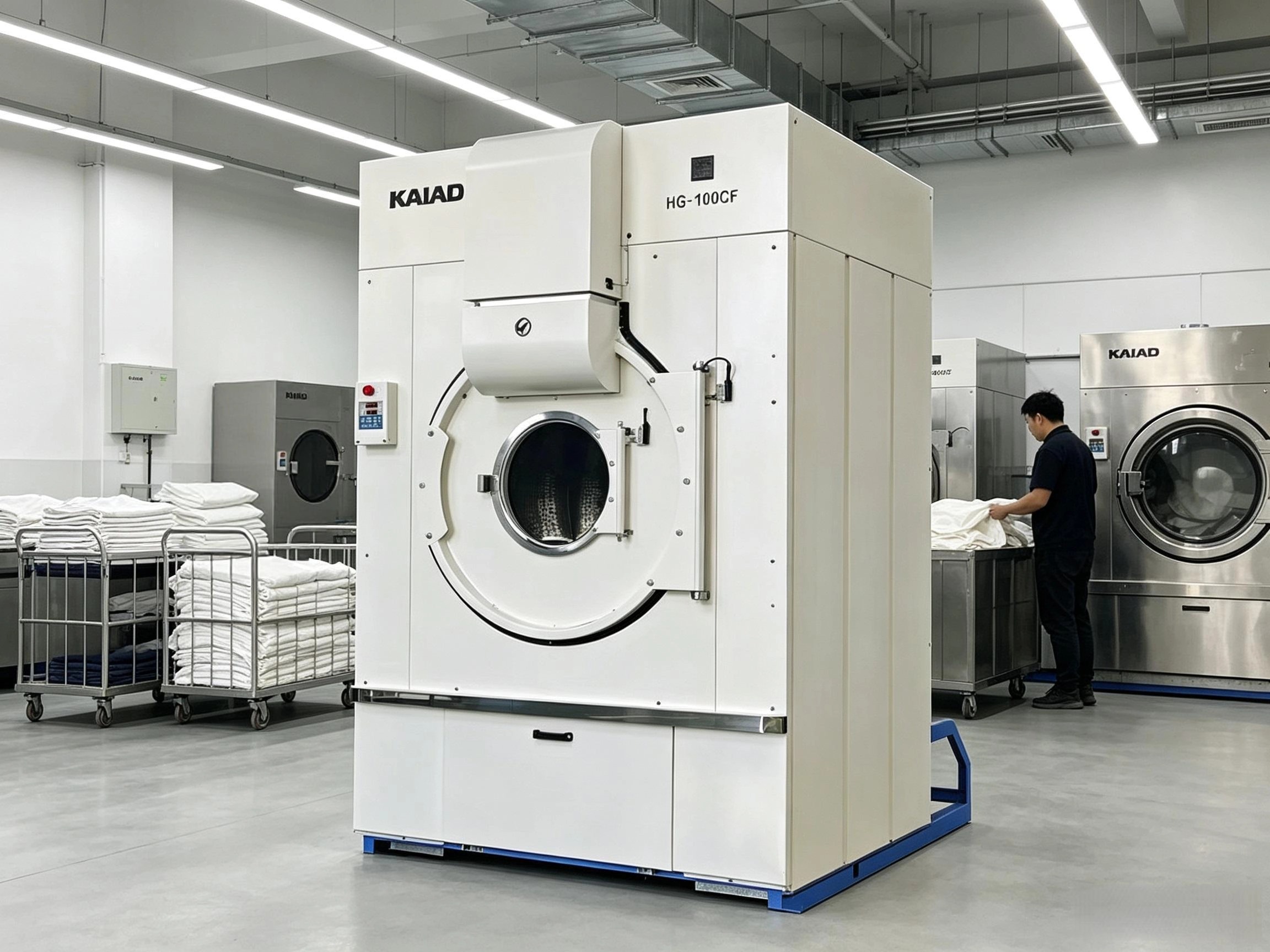
In contrast, modern energy-saving dryers engineered with a front-intake negative pressure circulation design deliver substantially higher thermal efficiency. Taking representative high-efficiency models—such as the thermal-optimized KAIAO premium series—as an example, the combustion system is closely coupled with the air intake channel. Combined with multi-stage variable flame temperature control, hot air penetrates the tumbling linen along the shortest possible thermodynamic path. Consequently, drying time for a 120kg batch is compressed to just 32 to 38 minutes, while gas consumption drops to only 6.5 to 7.8 m³ per batch, holding the gas cost down to 24.7 to 29.6 RMB per batch.
Comparing the two systems reveals a direct saving of 3.5 to 5.2 m³ of natural gas and a cost reduction of 13 to 20 RMB per batch.
Assuming a laundry facility runs a single 120kg unit for 15 batches per day, calculating with a median saving of 16 RMB per batch:
Daily savings: 240 RMB
Monthly savings (30 days): 7,200 RMB
Annual savings: Over 86,000 RMB
These tangible cost savings can offset the initial price difference of a high-efficiency machine in just over a year, not to mention the massive production capacity unlocked by cutting cycle times nearly in half. For commercial laundry enterprises, equipment is not merely a one-off capital asset; it is an active energy-consuming unit operating every single day. In an era of tight margins, choosing the right thermodynamic airflow architecture is the true key to protecting bottom-line profits.